Why Choose Bedford Hoses?
✓ Rigid and reliable connections
✓ Meets highest global safety standards
✓ Flexible and kink resistant
✓ Ages well

99 Productos


Two things decide which hose you want: how far you need to reach, and how much pressure you can afford to lose getting there. Material rubbing against the hose wall costs pressure over distance, and a wider hose loses noticeably less of it over the same run.
| Inside diameter | Typical use |
|---|---|
| 3/16" | Whip hose only — a short, limp section at the gun end for wrist movement. Not used as a main run. |
| 1/4" | The standard airless hose and the most common choice. Suits most jobs on typical run lengths. |
| 3/8" | Long runs and higher-output sprayers. Heavier and dearer than 1/4", but it holds pressure far better over distance. |
| 1/2" and larger | High-output and industrial equipment moving heavy material over long distances. |
| 3/4" and 1" | Suction and return lines — low-pressure hose that feeds the pump rather than carrying material to the gun. |
For runs beyond about 100 feet, common practice is to put the larger 3/8" hose on the main run from the sprayer and finish with a length of 1/4" hose or a whip at the gun. You keep the pressure and still get a manageable hose in your hand.
A hose must be rated at or above your sprayer's maximum working pressure. Bedford stocks assemblies rated from 3300 PSI up to 10,000 PSI for high-pressure equipment, and the rating is stated on every product page. Check it against the plate on your machine before ordering, and never put a lower-rated hose on a higher-pressure sprayer.
| Type | What it does | Notes |
|---|---|---|
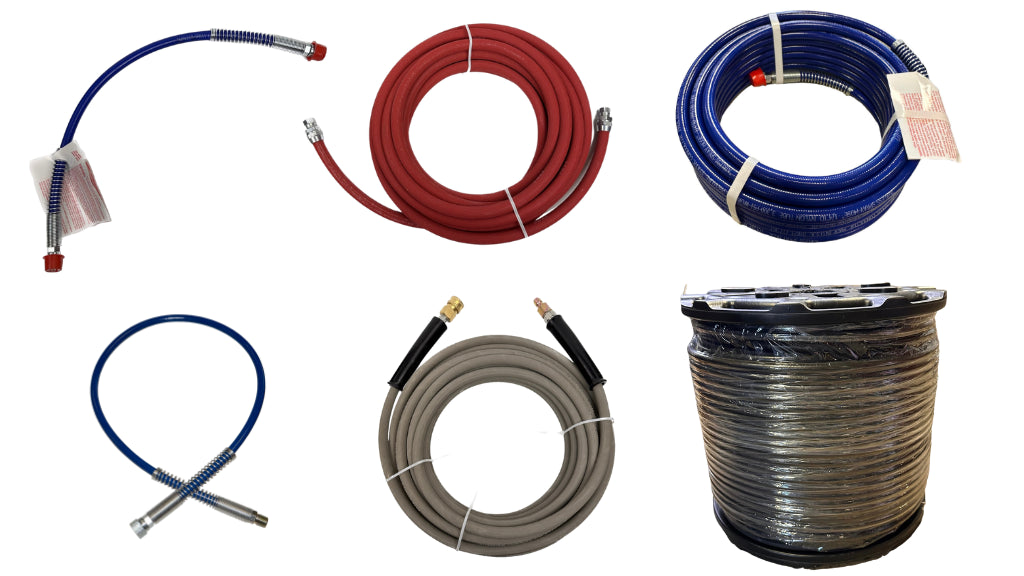
| Airless hose assemblies | The main high-pressure run from the sprayer to the gun. Stocked in 25', 50', 75', and 100' lengths in the common diameters. | The bulk of this collection. Match the pressure rating to your machine. |
| Whip hoses | A short, flexible section between the main hose and the gun, typically 3' to 6' in 3/16" or 1/4". | Takes the weight and stiffness of the main hose off your wrist. Still must carry a full pressure rating. |
| Suction hose assemblies | Carry material from the bucket into the pump. Low pressure, large bore — 3/4" and 1" ID. | Sold as assemblies and in cut lengths. Not interchangeable with high-pressure hose. |
| Return and drain hoses | Route material back to the bucket during priming and pressure relief. | Machine-specific — check the model list on the product page. |
| Poly tubing | Small-bore tubing for ancillary feed and drain lines on specific machines. | Matched to the equipment it serves. |
1/4" is the standard and suits most work. Step up to 3/8" for long runs or a high-output sprayer, where holding pressure at the gun matters more than hose weight. 3/16" is for whip hose at the gun only.
Yes, and it is common practice on long runs — a 3/8" main length into a 1/4" length or whip at the gun. Every section must be rated at or above your sprayer's maximum pressure; the lowest-rated piece governs the whole run.
Pressure drop over distance. The longer and narrower the hose, the more pressure you lose between pump and gun. A larger-diameter main run recovers most of it; winding the pump up to compensate just wears the tip faster.
Flexibility at the gun. A short 3' to 6' section in a smaller diameter takes the stiffness of the main hose off your wrist over a long day, without changing the setup upstream.
At or above your sprayer's maximum working pressure, which is on the machine's data plate. Bedford stocks assemblies from 3300 PSI through 10,000 PSI, and every product page states its rating.
No — Bedford hoses are compatible replacements, not genuine Graco, Titan, Wagner, or other OEM parts. Each is manufactured to OEM-equivalent dimensions and pressure ratings so it fits and performs like the assembly it replaces, at a lower price.
Bedford hose and tubing assemblies are compatible replacements cross-referenced to the original manufacturers' part numbers, including Graco, Titan, Wagner, and Speeflo. Search the OEM part number from your equipment manual — dashes optional — or open the Custom Lookup Tool to match a hose to your machine. Related ranges: filters and strainers, connectors and fittings, and spray guns.
BEDFORD® and BEDFORD PRECISION PARTS™ are proprietary marks of Bedford Precision Parts, LLC ("Bedford"). All other listed marks are proprietary to their respective owners and are not affiliated with Bedford.
✓ Rigid and reliable connections
✓ Meets highest global safety standards
✓ Flexible and kink resistant
✓ Ages well