How to read a tip number
Every reversible tip uses the same three-digit code, and once you can read it you can pick a tip without a chart:
- First digit × 2 = fan width in inches, measured about 12" from the surface. A 415 sprays roughly an 8–10" fan; a 210 sprays about 4".
- Last two digits = orifice size in thousandths of an inch. A 415 has a .015" orifice; a 210 has a .010" orifice.
Fan width controls how much surface you cover per pass — narrow fans for trim and cabinet frames, wide fans for doors and walls. Orifice controls how much material flows, so it has to suit the coating: thin materials such as stains and lacquers need a small orifice, while heavier latex paints need a larger one. Match both to the job, and remember that a worn tip sprays a narrower fan and heavier edges than a new one.
Fine finish low pressure tip size chart
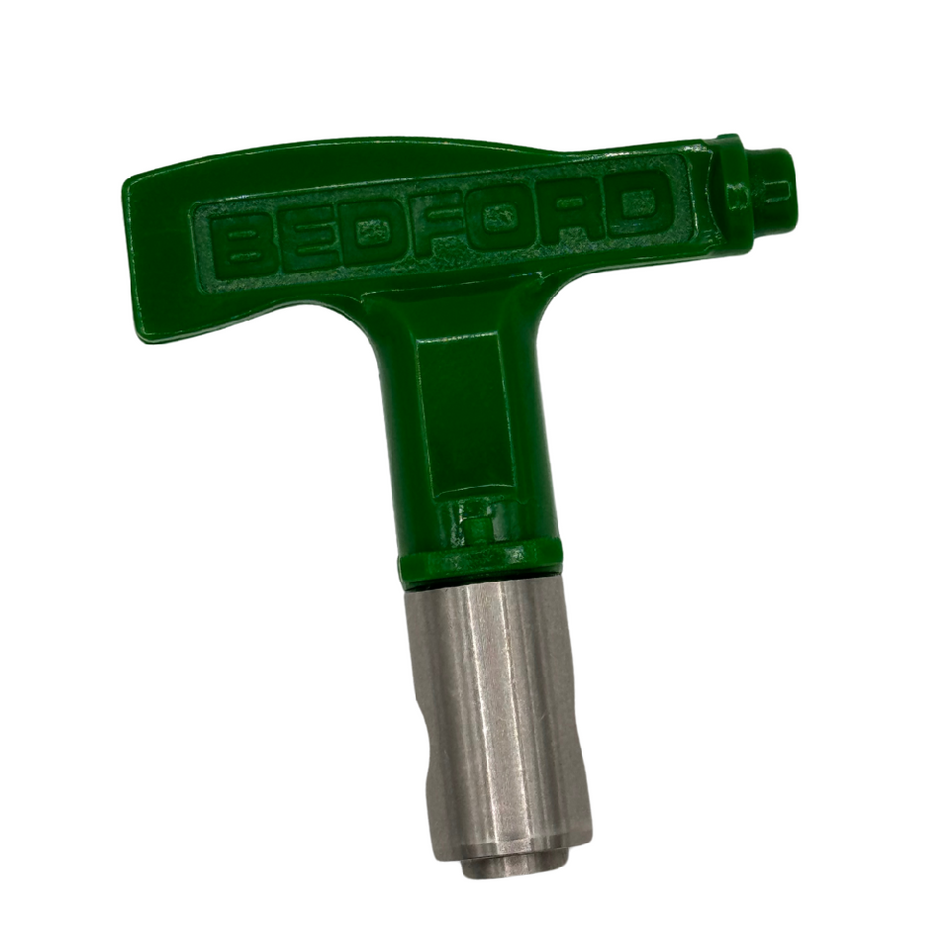
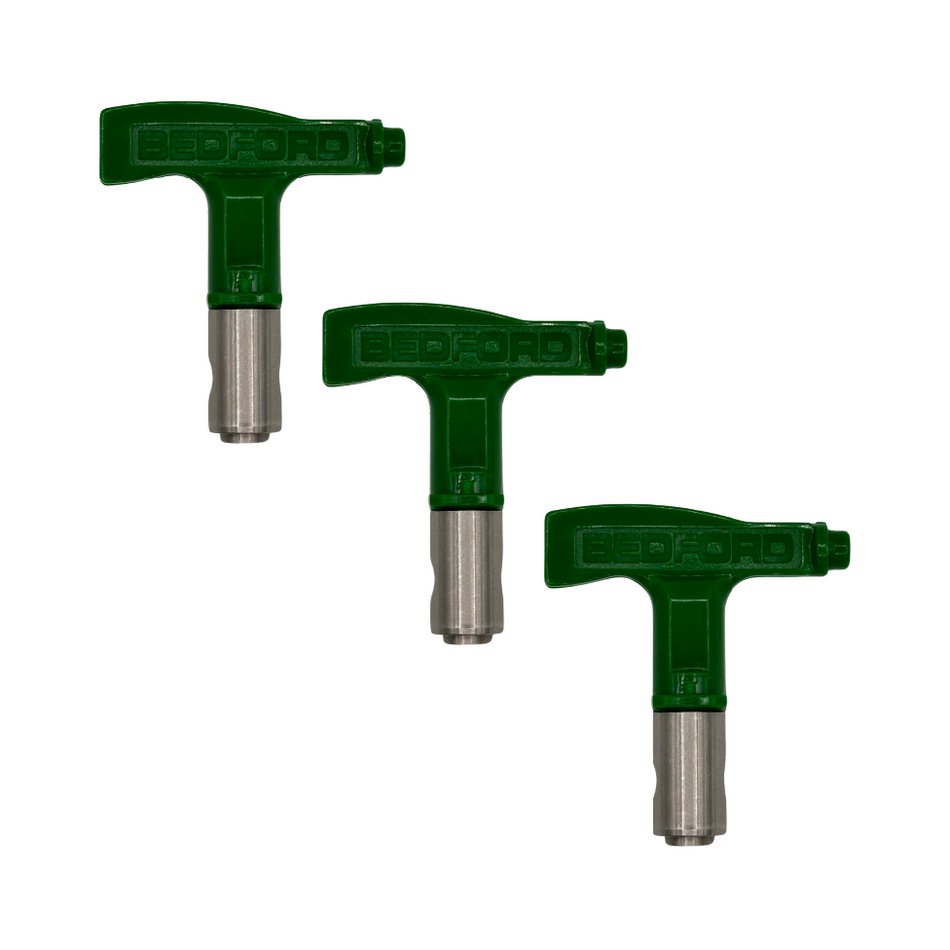
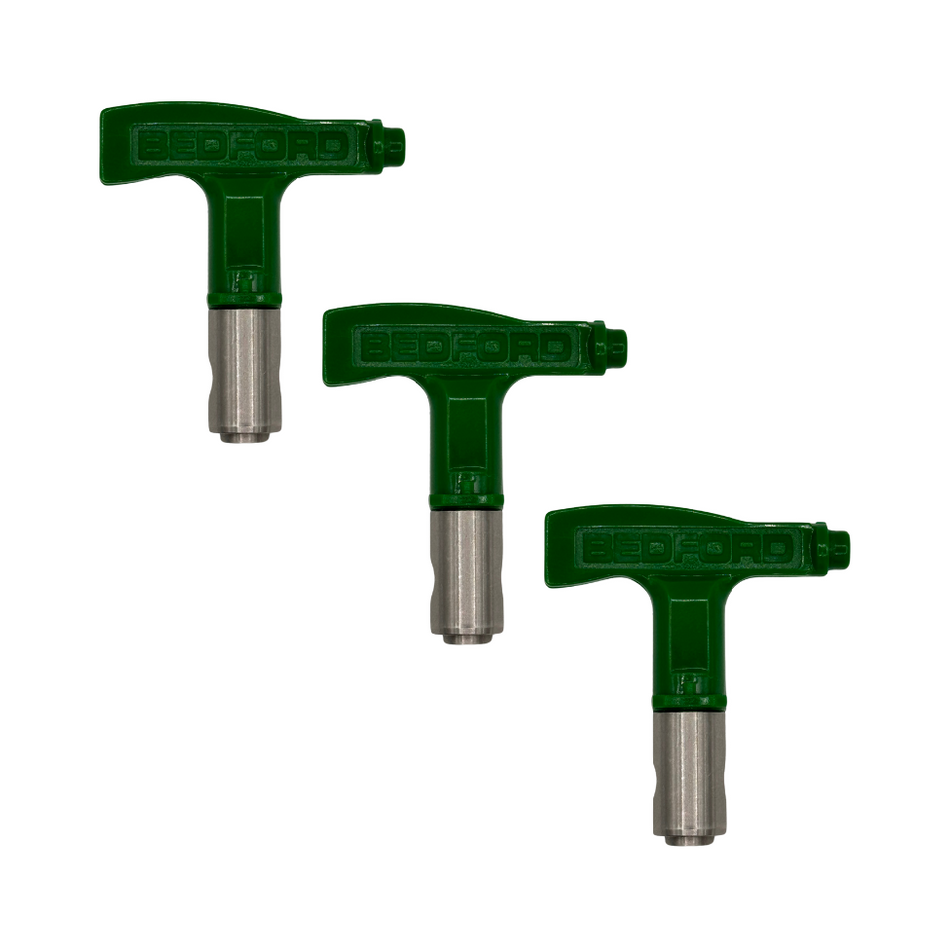
All 30 sizes below are stocked as singles, 3-packs, and 10-packs. Orifice and fan figures are Bedford's published specifications for each tip.
| Tip | Orifice | Fan width | Typical use |
|---|
| 208 | .008" | 4" | Detail work — trim, cabinet frames, narrow surfaces. Thin materials such as stains and lacquers. |
| 210 | .010" | 4" | Detail work on trim, doors, and cabinets. Stains, sealers, and light-bodied enamels. |
| 214 | .014" | 4" | Narrow fan with more flow — enamels and primers on trim and detail surfaces. |
| 308 | .008" | 6–8" | Fine finish on doors and trim. Stains, lacquers, and other thin coatings. |
| 310 | .010" | 6–8" | The common cabinet and trim size — stains, sealers, and light enamels. |
| 311 | .011" | 6–8" | Slightly more flow than a 310 for light-bodied enamels and lacquers. |
| 410 | .010" | 8–10" | Doors, cabinet boxes, and panelled surfaces in thin materials. |
| 412 | .012" | 8–10" | Fine finish coverage in lacquers, varnishes, and light enamels. |
| 413 | .013" | 8–10" | Enamels and primers where a wider fan speeds the work. |
| 415 | .015" | 8–10" | A workhorse size — enamels, primers, and thinned latex on doors and trim. |
| 417 | .017" | 8–10" | Heavier enamels and primers needing more flow at a fine finish. |
| 420 | .020" | 8–10" | Latex and heavier coatings where finish quality still matters. |
| 512 | .012" | 10–12" | Wide fan in a light material — large panels and cabinet runs. |
| 514 | .014" | 10–12" | Enamels and primers across broader surfaces. |
| 515 | .015" | 10–12" | The most common all-round size — primers, enamels, and thinned latex on walls and doors. |
| 516 | .016" | 10–12" | General interior work in latex and enamel with a fine finish. |
| 517 | .017" | 10–12" | Walls and ceilings in latex where overspray control matters. |
| 519 | .019" | 10–12" | Heavier latex paints across large interior surfaces. |
| 521 | .021" | 10–12" | High-build latex and heavier coatings at production speed. |
| 523 | .023" | 10–12" | Thick latex and elastomeric-style coatings on broad surfaces. |
| 525 | .025" | 10–12" | The heaviest materials in this fan width — maximum flow. |
| 612 | .012" | 12–14" | Widest fan in a light material — fast coverage on large flat panels. |
| 614 | .014" | 12–14" | Enamels and primers over large areas. |
| 616 | .016" | 12–14" | Latex and enamel on walls, ceilings, and large panels. |
| 617 | .017" | 12–14" | Production interior work in latex with reduced overspray. |
| 618 | .018" | 12–14" | Heavier latex across the widest practical fan. |
| 619 | .019" | 12–14" | Large-area latex work where speed is the priority. |
| 621 | .021" | 12–14" | High-build coatings over broad surfaces. |
| 623 | .023" | 12–14" | Thick latex and heavy-bodied materials at maximum coverage. |
| 625 | .025" | 12–14" | The largest tip in the range — heaviest materials, widest fan. |
Working out a size for stain, cabinet enamel, or latex? The spray tip size guide walks through choosing orifice and fan width by material.
Fine finish low pressure vs. fine finish tips
Bedford stocks these as two separate families, and they are not interchangeable. The difference is the guard they fit and the pressure they are designed to spray at:
| Fine finish low pressure (this collection) | Fine finish |
|---|
| Fits | Large-barrel RAC X style guards | RAC 5 and SC-6 style guards |
| Spray pressure | Designed to atomize at up to 50% lower pressure | Standard airless pressure |
| Cross-referenced to | Graco fine finish low pressure series | Graco 671-series and Titan SC-6 tips |
| Best for | Lower overspray and a softer edge on trim, doors, cabinets, and fine woodwork | Smooth atomization on trim, cabinets, doors, and furniture |
Spraying at lower pressure puts less material into the air, which means less overspray, less bounce-back on interior work, and noticeably longer tip life — pressure is what wears an orifice out. Check which guard your gun uses before ordering, since the barrel sizes differ between the two families.
Getting longer life from a tip
- Spray at the lowest pressure that fully atomizes. Turn the pressure down until the fan just begins to show tails, then bring it back up slightly. Excess pressure erodes the orifice without improving the finish.
- Strain your material and keep the filters in. Most tip clogs and premature wear trace back to debris. Gun and manifold filters cost far less than tips.
- Clear clogs by reversing the tip, not by picking at the orifice — anything pushed into the carbide will change the fan pattern permanently.
- Watch the fan width. When a tip sprays noticeably narrower than its rating and lays heavy edges, the orifice has worn oversize; it is using more material and costing more than a new tip.
Fine Finish Low Pressure Tip FAQ
What does the tip number mean?
The first digit doubled gives the fan width in inches at about 12" from the surface, and the last two digits give the orifice size in thousandths of an inch. A 415 sprays roughly an 8–10" fan through a .015" orifice.
Will these fit my Graco gun?
These tips are built for large-barrel RAC X style guards. If your gun uses a RAC 5 or SC-6 guard, you need the fine finish tips instead — the barrel sizes are different. Each product page lists the equipment it is compatible with; check that list before ordering.
How is this different from a standard tip?
A low pressure fine finish tip is engineered to break up material properly at a much lower pressure than a standard tip needs. You get less overspray, softer edges, and longer tip life, which is why they suit trim, cabinets, and finish carpentry where a standard tip would put too much material into the air.
Are these genuine Graco tips?
No — Bedford tips are compatible replacements, not genuine Graco parts. Each is manufactured to OEM-equivalent dimensions so it fits the same guards and sprays the same rated fan and orifice as the tip it replaces, at a lower cost per tip.
Which size should I start with?
For stains, lacquers, and other thin materials on trim and cabinets, a 310 is the usual starting point. For enamels and primers on doors and trim, a 415 is the common choice, and for latex on walls a 515 covers most interior work. Move the last two digits up for heavier material and the first digit up for a wider fan.
What sizes and pack quantities are available?
Thirty sizes from 208 through 625, each stocked as a single tip, a 3-pack, or a 10-pack. Multi-packs are the usual choice for crews running the same size on repeat work.
Compatibility and cross-reference
Bedford fine finish low pressure tips are compatible replacements cross-referenced to Graco's FFLP series of RAC X reversible tips. Search the OEM part number from your equipment manual — dashes optional — or open the Custom Lookup Tool to match tips to your machine. Related ranges: large barrel tips, standard tips, high pressure tips, and tip guards and accessories.
BEDFORD® and BEDFORD PRECISION PARTS™ are proprietary marks of Bedford Precision Parts, LLC ("Bedford"). All other listed marks are proprietary to their respective owners and are not affiliated with Bedford.